

Artificial Intelligence in HR in Kazakhstan: interest has gone mainstream, but companies are not yet ready to scale
75% of companies are already considering or using AI in HR, but only 23% use it actively. The market is looking for ways to move beyond pilot projects, yet processes, data and governance rules are still lagging behind.
The study covered 48 organizations: Kazakhstani private companies made up 58% of the sample, international ones 25%, and state-owned and quasi-state entities 13%. The study includes SMEs and large businesses, companies that are only exploring AI, and organizations with hands-on implementation experience.
Key points
-
Interest in AI is roughly three times higher than the level of its full-scale adoption.
-
Early results are concentrated primarily in increasing speed and reducing the operational workload on HR.
-
The next wave of adoption will affect analytics, assessment, development and decisions about employees, processes with a higher cost of error.
-
69% of companies already using or testing AI operate without an approved policy.
Only a third of companies that have AI on their agenda reach active use
At each stage, from interest to sustained use, the number of companies drops noticeably. 75% of study participants are already considering or using AI, but only 23% use it actively.
The highest figure was recorded among organizations with more than 5,000 employees: 56% use AI actively. In companies with 500 to 5,000 employees the figure is 22%, and in small and medium-sized businesses it is 12–14%.
The main difference between companies now lies not in their interest in AI, but in their ability to embed it into a specific process, supply it with the necessary data, assign accountability and achieve the expected result.
General-purpose AI assistants boost speed but so far have limited impact on management quality
Respondents report using the following tools: 72% use ChatGPT, 44% Microsoft Copilot, 40% Claude. These are general-purpose assistants, convenient for drafting texts, processing information and automating individual tasks. For most, they are not embedded into corporate HR processes and do not run on the company's unified HR data model.
That is why AI is more often applied where a task is easier to formalize and verify. It is used in recruitment by 35% of companies, in preparing documents and policies by 25%, and in HR operations by 23%. In more sensitive processes the figures are significantly lower: 8% of companies use AI in performance management, and 6% in onboarding and offboarding.
The nature of the effect obtained matches the tools chosen. Among the 26 companies already using or testing AI, the most common effects were higher speed and efficiency of work, noted by half of the companies; and more structured execution of HR processes, noted by nearly a third of participants. At the same time, nearly a third of companies do not yet see a noticeable effect.
The current effect has predictably stalled mainly at speed: the market has mastered general-purpose tools but has not yet embedded them into cohesive HR processes.
Plans are shifting toward the most sensitive processes, while readiness lags behind
In the coming years, companies intend to significantly expand their use of AI. The market is moving from drafting texts and automating routine tasks toward processes that affect employee assessment, development, pay and employment. While AI is currently used mainly in recruitment, by 2026–2027 its use will grow most substantially in performance management — 5.5 times, in onboarding and offboarding — 6.3 times, and in learning and development — 3.1 times. In these processes, errors in data or decision logic can have considerably more serious consequences.
Chart 1: Current and planned use of AI in HR processes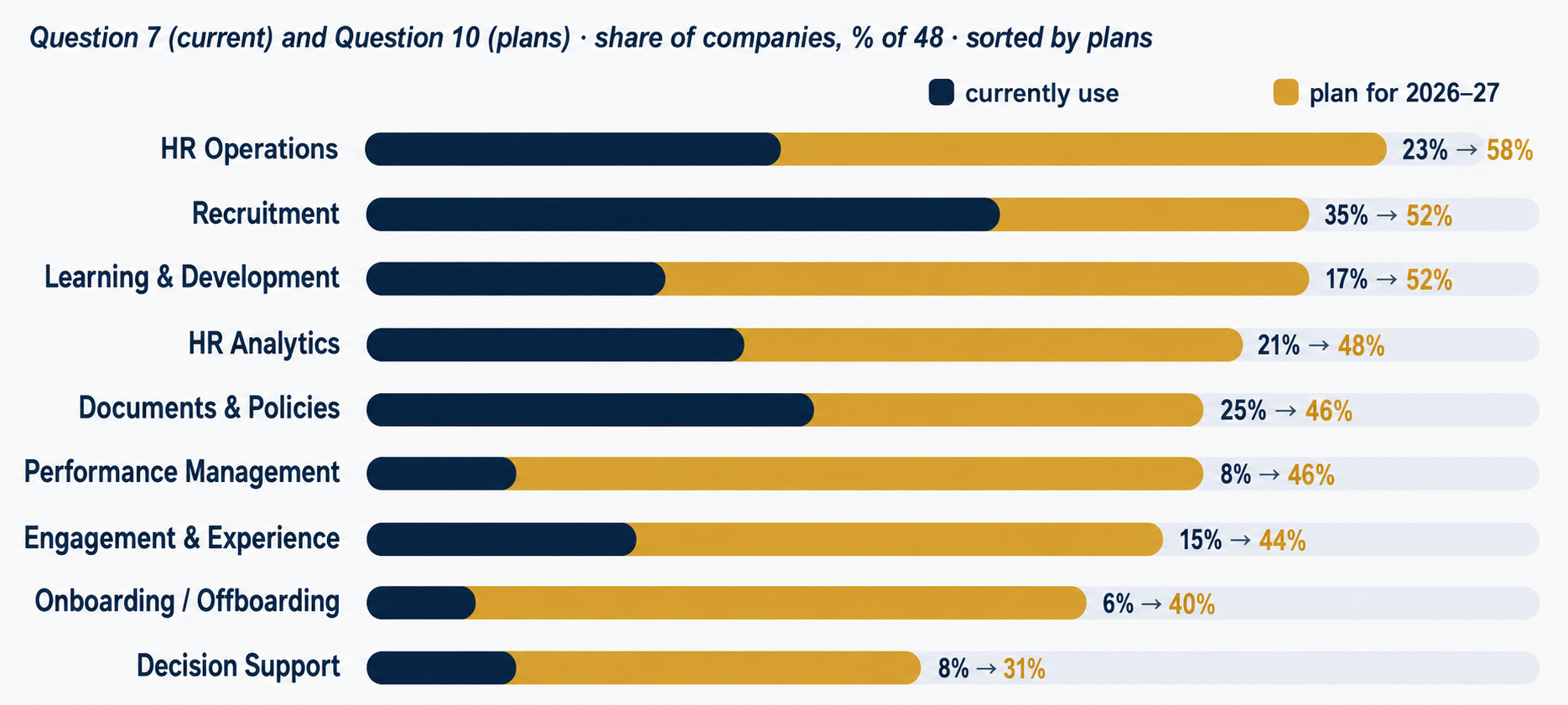
Against this backdrop, the study reveals three significant gaps.
Analytics and data. 48% of companies plan to use AI analytics, but only 23% consider their data ready. Almost half of the market plans to build analysis and forecasts, although fewer than a quarter of companies are confident in the completeness, quality and comparability of their source data.
HR processes. 85% of companies plan to use AI in at least one HR process, but only 15% consider their processes mature. Maturity is understood as a unified way of working, defined roles, decision-making criteria, metrics and control points.
People and change. 46% of companies understand the goals of adoption, but only 19% confirm their readiness to manage change. In other words, the expected effect has already been articulated, but most organizations have not yet defined who is responsible for changing the way work is done, a phased implementation plan, or a communications plan.
Among the 22 companies testing or planning AI, 45% are doing so on immature processes. As a result, the technology may accelerate individual operations while preserving manual approvals, fragmented data and inconsistent decision criteria.
The main risk of the next wave of adoption is carrying the shortcomings of the current process into an automated environment and then scaling them across the entire organization.
The use of external AI services has already outpaced internal controls
Among companies already using or testing AI, 69% have no formalized rules for its use (an approved AI policy). It is highly likely that employees are choosing tools on their own and feeding work information into them without common requirements. For owners and management, this is no longer a local HR matter but a question of data protection, governance and accountability.
Where the line between AI and humans in HR should be drawn
The line between AI and humans should depend on the significance of the decision. AI can coordinate meetings, process data, answer routine questions, prepare drafts and identify patterns. Decisions on hiring, promotion, pay, final assessment and disciplinary action should for now remain with humans.
The working principle: AI prepares, the human reviews and decides. The more a decision affects an employee, the higher the level of human oversight should be.
From experiments to managed adoption
The study's results show that the next stage of AI use in HR is linked not to increasing the number of tools and pilots, but to preparing the conditions to scale them. Before deploying AI in analytics, assessment or other sensitive processes, companies need to define priority scenarios, verify data quality and process maturity, assign roles and establish rules for using the technology.
The specific next step depends on the current situation. If a company has not yet decided where to start, a readiness assessment is needed. If employees are already using AI without common requirements, policy and data-handling controls become the priority. Before scaling, processes, metrics and control points must be updated, followed by training and change support. Only solutions that have demonstrated a measurable effect and an acceptable level of risk should be scaled.
About the authors. The study was prepared by the HR Consulting team at Fortune Partners. Daniyar Seitkhozhin – CIPD, Head of the HR Consulting practice, has 14 years of experience in human resource management, including eight years at Big Four firms (EY, PwC) in Kazakhstan and the Gulf states. Dana Tokmurzina – CEO and founder of Fortune Partners, member of the Public Council of the Ministry of National Economy of the Republic of Kazakhstan, former partner in the tax and legal practice at PwC, a Supreme Court judge, and a World Bank expert.

